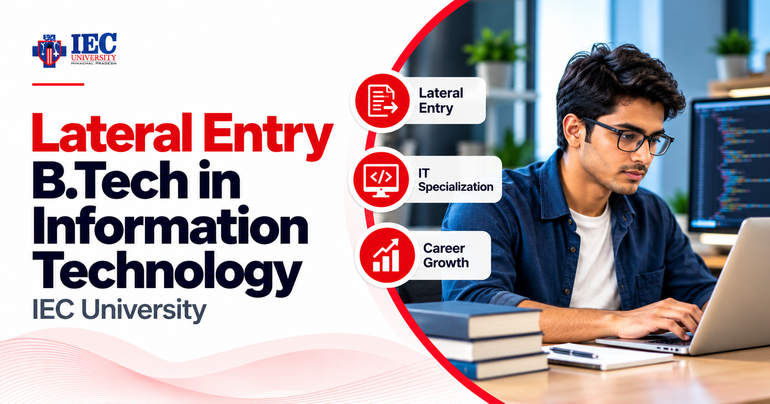
Lateral Entry B.Tech in Information Technology is an option for eligible diploma holders who want to advance their technical education and build a career in the IT industry. Instead of beginning a conventional four-year engineering programme from the first year, eligible candidates may enter through a lateral-entry route and complete the remaining degree requirements under the applicable programme structure.
For students and working professionals interested in software development, computer systems, networking, databases, and information technology, this pathway can help strengthen their engineering knowledge and professional qualifications.
IEC University promotes engineering programmes designed for students with prior technical qualifications. However, applicants should confirm whether Information Technology is available as a separate lateral-entry specialisation for their intended admission session, as the university’s published programme lists may use different branch names.
Table of Contents
ToggleIEC University Lateral Entry B.Tech in IT: Overview
| Particulars | Details |
|---|---|
| University | IEC University |
| Programme | B.Tech Lateral Entry in Information Technology |
| Degree Level | Undergraduate Engineering |
| Typical Duration | 3 years for an eligible lateral-entry route |
| Entry Qualification | Eligible engineering diploma or other accepted qualification |
| Study Areas | Programming, databases, networking, software and IT systems |
| Suitable For | Diploma holders and eligible working professionals |
| Admission Mode | As prescribed by the university |
| Specialisation Availability | Confirm with the university for the current intake |
The programme details, eligibility conditions, teaching format, and available specialisations should be verified with IEC University before applying. A three-year duration is typical of lateral-entry engineering pathways, but the applicable academic structure must be confirmed for the specific programme.
What Is Lateral Entry B.Tech in Information Technology?
Lateral entry is an admission route that allows eligible candidates with a qualifying prior education to enter an advanced stage of an engineering degree instead of starting from the first year.
Information Technology focuses on the systems used to store, process, secure, and exchange information. Students develop an understanding of software applications, computer networks, databases, programming, and IT infrastructure.
For diploma holders, lateral entry can provide a way to continue their education at degree level. Working professionals may also explore eligible programmes to strengthen their technical knowledge while planning their next career step.
However, not every work-integrated or flexible engineering programme follows the same admission rules as a conventional university-affiliated lateral-entry course. Applicants should verify the exact route offered by the institution.
Why Choose Information Technology Engineering?
Information Technology is relevant to organisations that depend on digital systems, software applications, cloud services, databases, and secure networks.
An IT-focused engineering education can help students develop technical knowledge that is useful across several industries.
1. Learn Programming and Software Fundamentals
Programming is an important part of IT education. Students learn how applications are developed, how code is structured, and how software problems can be identified and resolved.
Depending on the syllabus, students may study programming languages such as Python, Java, or C.
2. Understand Databases and Information Systems
Organisations use databases to manage customer information, financial records, business transactions, and operational data.
Database-related subjects introduce students to data organisation, querying, storage, and information management.
3. Develop Networking Knowledge
Computer networking explains how computers and other devices communicate. Students may learn about network architecture, communication protocols, connectivity, and troubleshooting.
These concepts are useful for IT support, infrastructure management, and network-related career paths.
4. Explore Cybersecurity Fundamentals
Information security is an important consideration for businesses and technology providers. IT students may learn about access controls, common security risks, system protection, and secure information handling.
Specialised cybersecurity careers usually require additional practical training and deeper knowledge.
5. Build Technical Problem-Solving Skills
Engineering education involves understanding technical problems, evaluating possible solutions, and applying concepts to practical situations.
Projects, laboratory activities, and assignments can help students develop analytical thinking and technical confidence.
IEC University B.Tech Lateral Entry Eligibility
Eligibility depends on the exact programme, admission route, and applicable university regulations. Students should obtain the current eligibility criteria before submitting an application.
Diploma Holders
Candidates with a recognised engineering or technology diploma may be eligible for certain lateral-entry B.Tech programmes.
The university may specify requirements relating to the diploma branch, minimum marks, and the qualification’s recognition status.
B.Sc. Graduates
Some lateral-entry routes accept eligible B.Sc. graduates who satisfy the prescribed subject and academic requirements.
Mathematics at the qualifying level and minimum aggregate marks may be required, depending on the programme.
Working Professionals
Working professionals should confirm whether their chosen programme is specifically designed for employed candidates.
Some work-integrated programmes require relevant professional experience in addition to an eligible diploma or degree. These conditions should not be assumed to apply uniformly across all B.Tech programmes.
Documents Commonly Required
Applicants may need the following documents, depending on the university’s admission process:
- Class 10 marksheet and certificate
- Class 12 marksheet, where applicable
- Engineering diploma or qualifying degree certificate
- Academic transcripts or marksheets
- Identity proof
- Recent photograph
- Work-experience documents, if required
- Other documents specified by the university
Ensure that your previous qualification is accepted for the selected Information Technology programme before proceeding with enrolment.
Lateral Entry B.Tech in IT: Course Structure
The Information Technology syllabus generally combines programming, computing fundamentals, networking, databases, and software development. The exact subjects and semester sequence depend on the university and the approved curriculum.
The following is an illustrative subject structure, not a confirmed semester-wise syllabus for IEC University.
| Subject Area | Topics Covered |
|---|---|
| Programming Fundamentals | Programming logic, variables, functions and problem-solving |
| Data Structures | Arrays, linked lists, stacks, queues and algorithms |
| Database Management Systems | Database design, SQL and data organisation |
| Computer Networks | Network architecture, communication and protocols |
| Operating Systems | Processes, memory management and system resources |
| Software Engineering | Software development processes, testing and maintenance |
| Web Technologies | Website structure, frontend fundamentals and web applications |
| Computer Security | Security principles, access control and risk awareness |
| Cloud Computing | Cloud concepts, virtual infrastructure and service models |
| Project Work | Applying technical knowledge to a practical problem |
Students should request the official syllabus from the university to understand which subjects, practical sessions, and projects are included in their specific programme.
Admission Process for IEC University B.Tech Lateral Entry
Students interested in this programme can generally prepare for admission by following these steps. The precise procedure may differ depending on the programme and admission category.
Step 1: Confirm the Available Specialisation
Contact IEC University to confirm whether B.Tech Lateral Entry in Information Technology is offered for the current intake.
Ask whether the programme is listed separately from Computer Science Engineering and whether your previous qualification is suitable for the IT branch.
Step 2: Check the Eligibility Criteria
Review the required diploma or degree, minimum marks, subject conditions, and any work-experience requirements.
Request written confirmation if the information on different programme pages appears inconsistent.
Step 3: Complete the Application
Use the university’s official admission process to submit your application and provide accurate academic and personal details.
Step 4: Submit the Required Documents
Upload or submit the documents requested by the admissions team. Ensure that your name, marks, qualification details, and other information match your official records.
Step 5: Complete Verification and Enrolment
Follow the university’s instructions for eligibility verification, admission confirmation, and any applicable payment formalities.
Step 6: Understand the Academic Requirements
Before confirming admission, ask about the semester structure, attendance requirements, practical sessions, examinations, projects, and completion rules.
These details are particularly important for students who plan to continue working while studying.
Career Opportunities After B.Tech in Information Technology
A B.Tech in Information Technology can prepare graduates to explore technical roles across software companies, IT service providers, financial organisations, healthcare businesses, retail companies, and other technology-dependent industries.
Career opportunities depend on practical skills, experience, employer requirements, and the technologies used in each position.
| Job Role | Main Responsibilities |
|---|---|
| Software Developer | Developing, testing and maintaining software applications |
| Web Developer | Building and maintaining websites and web applications |
| IT Support Engineer | Troubleshooting hardware, software and user issues |
| Network Support Engineer | Supporting network connectivity and infrastructure |
| Database Support Associate | Assisting with database operations and data management |
| Software Testing Engineer | Testing applications and identifying defects |
| Systems Administrator | Supporting operating systems, servers and IT resources |
| Cloud Support Associate | Assisting with cloud services and infrastructure |
| Cybersecurity Analyst | Monitoring security risks and supporting protective measures |
| Business Analyst | Understanding business requirements and supporting technology solutions |
Some positions require additional certifications, specialised knowledge, or prior experience. Students should review the skills requested in job advertisements and develop practical experience alongside their academic studies.
Skills to Develop During the Programme
To make the most of an Information Technology engineering qualification, students should focus on practical skills as well as academic subjects.
Programming Skills
Learn one programming language thoroughly before moving to additional languages. Practise coding, debugging, algorithms, and basic application development.
Database Knowledge
Develop an understanding of SQL, database design, data relationships, and information retrieval.
Networking Fundamentals
Learn about IP addressing, network protocols, troubleshooting, and basic network security.
Web and Application Development
Create small applications or websites to understand how software components work together.
Project Experience
Build projects that demonstrate your technical abilities. Examples include a database application, a website, a simple inventory system, or a basic network-monitoring tool.
Communication and Teamwork
IT professionals often collaborate with developers, managers, clients, and other technical teams. Clear communication and documentation can improve workplace performance.
What Should You Verify Before Taking Admission?
Before enrolling in IEC University’s lateral-entry engineering programme, confirm the following points with the admissions team.
- Whether Information Technology is available as a separate specialisation for the current session.
- Whether your diploma or degree qualifies you for lateral entry.
- The exact duration and semester structure.
- Whether the programme is conventional, work-integrated, or delivered through another approved format.
- The applicable recognition, approval, and affiliation details for the specific programme.
- The location and format of examinations and practical sessions.
- Attendance, project, and assessment requirements.
- The complete fee structure and any additional charges.
Do not rely solely on a general advertisement or a programme page for another engineering branch. The exact qualification and mode of study should match the course you intend to pursue.
Conclusion
Lateral Entry B.Tech in Information Technology can be a useful pathway for eligible diploma holders and other qualified candidates who want to continue their engineering education and develop skills in programming, databases, networking, software development, and IT systems.
IEC University promotes lateral-entry engineering options for eligible learners, including working professionals. However, applicants should confirm whether Information Technology is available as a separate specialisation in the current intake, as programme lists and eligibility requirements can vary.
Before applying, verify your eligibility, the exact syllabus, the academic format, and the programme’s applicable recognition and approval details. A carefully chosen engineering programme, supported by practical projects and technical skill development, can help you prepare for future opportunities in the IT sector.
Frequently Asked Questions
1. What is lateral-entry B.Tech in Information Technology?
It is an engineering degree pathway that allows eligible candidates with a qualifying previous education to enter an advanced stage of a B.Tech programme rather than beginning from the first year.
2. Does IEC University offer B.Tech lateral entry in Information Technology?
IEC-related programme listings include IT among certain B.Tech lateral-entry options, while the university’s current work-integrated programme pages list specific engineering branches separately. Confirm the availability of IT as a distinct specialisation for your intended intake directly with IEC University.
3. What is the duration of B.Tech lateral entry?
Eligible lateral-entry engineering programmes commonly follow a three-year structure. Confirm the exact duration and semester requirements for the programme you intend to join.
4. Who can apply for lateral-entry B.Tech in IT?
Eligible engineering diploma holders may qualify for certain programmes. Some routes also accept B.Sc. graduates who satisfy the relevant academic and subject requirements. The university’s current criteria determine eligibility.
5. Can working professionals pursue lateral-entry B.Tech?
Some programmes are designed for working professionals and offer flexible academic arrangements. Candidates should confirm the schedule, attendance, practical requirements, and examination format before enrolling.
6. What subjects are taught in B.Tech Information Technology?
Common subject areas include programming, data structures, database management, computer networks, operating systems, software engineering, web technologies, and computer security. The exact syllabus depends on the institution.
7. What jobs can I pursue after B.Tech in IT?
Graduates may explore software development, web development, IT support, network support, database operations, software testing, cloud support, and other technology-related roles.
8. Is B.Tech IT suitable for diploma holders?
Yes, where the candidate’s diploma and other qualifications meet the programme’s lateral-entry eligibility requirements. The accepted diploma branch and minimum marks should be verified with the institution.
9. What documents are required for admission?
Commonly requested documents include academic marksheets, a diploma or degree certificate, identity proof, a photograph, and work-experience documents where required. The university will provide the final checklist.
10. What should I check before applying to IEC University?
Confirm the availability of the IT specialisation, eligibility, duration, academic format, syllabus, practical requirements, examination arrangements, and applicable recognition and approval details before completing admission.