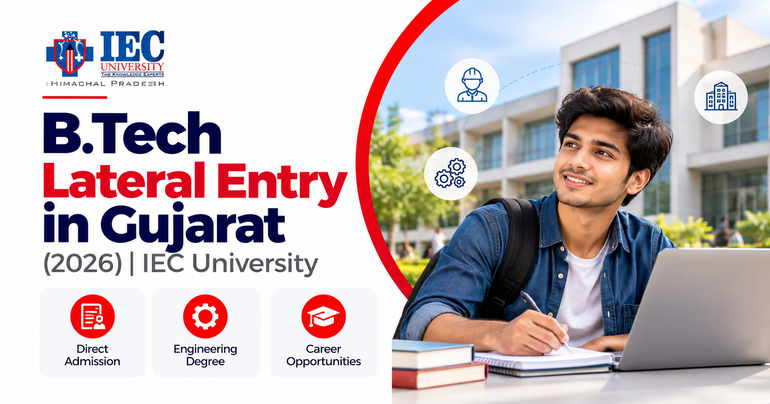
Many diploma holders and working professionals in Gujarat want to complete a Bachelor of Technology degree to improve their technical knowledge and expand their career opportunities. However, returning to a full-time college program can be difficult for people who already have jobs, family responsibilities, or professional commitments.
B.Tech lateral entry is an option for eligible candidates who have completed a relevant diploma or another qualifying educational program. Instead of following the regular four-year route, eligible students may enter an advanced year of the engineering program, subject to the applicable admission rules.
IEC University offers B.Tech lateral-entry programs in several engineering disciplines through its work-integrated learning offerings. Students from Gujarat who are considering IEC University should understand the eligibility criteria, available specializations, admission procedure, and recognition requirements before applying.
This guide explains the important details of B.Tech lateral entry in Gujarat for the 2026 academic session, with a focus on IEC University.
Table of Contents
ToggleWhat Is B.Tech Lateral Entry?
B.Tech lateral entry is an admission pathway that allows eligible candidates with prior technical education to enter an advanced year of an undergraduate engineering program.
It is particularly relevant for students who have completed a diploma in engineering and technology and want to continue their education at the degree level.
For example, a diploma holder in mechanical engineering may explore a suitable B.Tech program in mechanical engineering, provided the candidate satisfies the institution’s eligibility and branch-related requirements.
Lateral entry can help students build on their existing technical knowledge without repeating the entire first-year curriculum. However, admission to a particular year and the duration of study depend on the program structure and applicable regulations.
B.Tech Lateral Entry in Gujarat: Course Overview
Students living in Gujarat can explore engineering programs offered by institutions in Gujarat as well as universities located in other states. IEC University is based in Himachal Pradesh, so students should distinguish between studying in Gujarat and enrolling in a university located outside the state.
| Particulars | Details |
|---|---|
| Course name | Bachelor of Technology through lateral entry |
| University featured | IEC University |
| University location | Himachal Pradesh |
| Admission session | 2026–2027 |
| Typical lateral-entry duration | Three years, subject to the approved program structure |
| Target students | Eligible diploma holders and other qualifying candidates |
| Learning arrangement | Depends on the specific program and approved mode |
| Admission process | Application, document submission, and eligibility verification |
| Career areas | Engineering, manufacturing, construction, IT, electrical systems, and related industries |
Students should confirm the exact program, admission route, campus or study arrangements, and permitted learning mode before submitting an application.
Why Consider B.Tech Lateral Entry After a Diploma?
A diploma provides practical knowledge and foundational technical skills. However, some professional positions and career progression opportunities may require an engineering bachelor’s degree.
A suitable lateral-entry program can help eligible candidates continue their education while building on their previous studies.
1. Shorter Study Duration
A conventional B.Tech program usually takes four years. An approved lateral-entry pathway may allow eligible students to complete the degree in three years by entering the second year.
The actual duration must be confirmed for the selected program.
2. Advanced Technical Knowledge
An engineering degree can introduce students to advanced concepts, design methods, technical analysis, and specialised subjects relevant to their chosen branch.
3. Support for Career Development
Some employers require a bachelor’s degree for particular engineering positions or internal promotions. Completing an appropriate qualification may help candidates meet such requirements, although employment decisions remain with individual employers.
4. Opportunity for Further Education
After completing a recognised engineering bachelor’s degree, graduates may explore eligible postgraduate programs, technical certifications, or other professional development pathways.
Admission to further study depends on the relevant institution’s eligibility criteria.
B.Tech Lateral Entry Specializations at IEC University
IEC University’s work-integrated learning website lists several B.Tech lateral-entry specializations. The available offerings and eligibility conditions should be reconfirmed for the current admission session.
1. Computer Science Engineering
Computer Science Engineering focuses on computing systems, programming, software development, databases, and related technologies.
Depending on the curriculum, students may study programming fundamentals, data structures, algorithms, operating systems, database management, and computer networks.
Possible career paths include software development, web development, application support, testing, and other IT-related roles. Candidates need to develop practical technical skills alongside their academic knowledge.
2. Civil Engineering
Civil engineering focuses on infrastructure, construction, structural systems, and the built environment.
The curriculum may cover construction materials, surveying, structural analysis, geotechnical engineering, transportation engineering, and environmental engineering.
Graduates may explore roles in construction, infrastructure projects, site supervision, estimation, and technical project coordination, subject to their qualifications and employer requirements.
3. Mechanical Engineering
Mechanical engineering deals with machines, manufacturing systems, materials, thermal processes, and mechanical design.
Students may study engineering mechanics, thermodynamics, manufacturing processes, machine design, and industrial systems.
Career opportunities can include mechanical design, production, maintenance, quality control, manufacturing, and technical operations.
4. Electrical Engineering
Electrical engineering focuses on electrical circuits, power systems, electrical machines, control systems, and industrial electrical applications.
Graduates may pursue opportunities in electrical maintenance, power distribution, industrial systems, equipment testing, and related technical fields.
The specific job options depend on the candidate’s skills, practical training, and the eligibility criteria for individual roles.
5. Electrical and Electronics Engineering
Electrical and Electronics Engineering combines electrical systems with electronic devices, control technologies, and related engineering applications.
The curriculum may include electrical machines, power electronics, digital electronics, control systems, and embedded technologies.
Potential career areas include industrial automation, electrical systems, electronics applications, maintenance, and technical support.
6. Electronics and Communication Engineering
Electronics and Communication Engineering focuses on electronic circuits, communication systems, signal processing, and related technologies.
Students may study digital electronics, communication networks, microprocessors, electronic devices, and signal systems.
Possible career paths include electronics testing, communication systems support, embedded systems, and electronics-related technical roles.
Before choosing a specialization, applicants should confirm that the program is currently available, that their previous qualification is accepted, and that the learning and examination arrangements suit their needs.
Eligibility Criteria for B.Tech Lateral Entry
Eligibility requirements depend on the institution, engineering branch, admission route, and applicable regulatory rules.
IEC University’s program information lists diploma holders and certain B.Sc. graduates among the eligible categories for some lateral-entry programs. Other university information specifies additional academic and work-experience requirements for particular work-integrated programs.
The following points can help applicants prepare.
Educational Qualification
Candidates generally need a recognised diploma in engineering and technology or another qualification accepted for the selected program.
Some routes may also accept B.Sc. graduates who satisfy the relevant mathematics and academic requirements.
Minimum Marks
The required percentage depends on the program and applicable admission rules. Candidates should confirm the minimum marks and any category-based relaxation directly from the current program requirements.
Relevant Background
Applicants should check whether their diploma discipline is accepted for their chosen B.Tech specialization. A qualification in an unrelated field may not automatically qualify a candidate for every branch.
Work Experience
Some work-integrated programs may require relevant professional experience. Students should check whether experience is mandatory, preferred, or unnecessary for the exact course they intend to join.
Document Verification
Applicants must provide accurate educational and personal information. The university may request marksheets, certificates, identity proof, and other documents during the application or verification process.
Meeting the general eligibility criteria does not automatically guarantee admission.
Important Recognition and Learning-Mode Checks
Before applying to a B.Tech lateral-entry program, students should pay close attention to how the course is delivered and which approvals apply to it.
UGC guidance identifies engineering degrees offered through open and distance learning or online mode as prohibited, and AICTE guidance also restricts engineering degree programs through these modes.
Therefore, a university’s general recognition does not by itself establish that every engineering program or delivery format is permitted.
Applicants considering a work-integrated or flexible-timing B.Tech program should obtain written clarification about the exact degree, approved mode of instruction, required attendance, practical laboratory sessions, examination arrangements, and applicable regulatory approvals.
Students should not assume that a program described as online, flexible, or designed for working professionals is automatically equivalent to an approved regular engineering degree.
This check is especially important for students in Gujarat who are comparing programs offered by universities outside the state.
Admission Process for B.Tech Lateral Entry at IEC University
Students interested in IEC University’s B.Tech lateral-entry offerings can use the following general steps to prepare for admission.
Step 1: Select the Engineering Specialization
Choose a branch that matches your previous diploma or qualifying degree, technical interests, and career goals.
Computer Science Engineering, Civil Engineering, Mechanical Engineering, Electrical Engineering, Electrical and Electronics Engineering, and Electronics and Communication Engineering are among the specializations listed on the university’s work-integrated learning website.
Step 2: Review the Eligibility Criteria
Check the minimum marks, accepted qualifications, branch requirements, work-experience conditions, and other applicable admission rules.
Do not rely solely on a general eligibility statement if the selected specialization has separate requirements.
Step 3: Confirm Program Recognition and Delivery Mode
Before completing the application, request details about the exact program and its permitted learning mode.
Confirm how classes, practical work, laboratory sessions, examinations, and academic assessments are conducted.
Step 4: Complete the Application
Follow the university’s current admission instructions and provide the requested personal, academic, and contact information.
Check the information carefully before submitting the form.
Step 5: Submit Supporting Documents
Prepare the documents required by the university. These may include:
- Diploma or qualifying degree certificate
- Academic marksheets
- Class 10 certificate or other date-of-birth proof, if requested
- Government-issued identity proof
- Recent photograph and signature, where required
- Work-experience certificate, if applicable
- Other documents specified by the university
The final checklist depends on the selected program and admission route.
Step 6: Complete Verification
The university reviews the application and supporting records according to its admission process. Respond promptly if additional information or documents are requested.
Step 7: Confirm Admission Details
Before making a final commitment, obtain written confirmation of the specialization, study duration, learning mode, examination arrangements, applicable approvals, and academic requirements.
Keep a copy of the admission confirmation and other official communications.
Career Opportunities After B.Tech Lateral Entry
Career opportunities depend on the engineering branch, practical skills, previous work experience, and employer requirements. A degree can strengthen a candidate’s academic profile, but it does not guarantee a particular job title or salary.
| Engineering Branch | Potential Career Areas |
|---|---|
| Computer Science Engineering | Software development, testing, web applications, IT support |
| Civil Engineering | Construction, site supervision, estimation, infrastructure projects |
| Mechanical Engineering | Manufacturing, production, mechanical design, maintenance |
| Electrical Engineering | Power systems, electrical maintenance, industrial equipment |
| Electrical and Electronics Engineering | Automation, control systems, electrical and electronic applications |
| Electronics and Communication Engineering | Electronics testing, communication systems, embedded technologies |
Working professionals may also use their engineering education to strengthen their understanding of technical processes, improve their eligibility for certain internal roles, or prepare for further education.
Career outcomes depend on experience, demonstrated competence, practical exposure, and the opportunities available in the relevant industry.
Is B.Tech Lateral Entry in Gujarat Suitable for Working Professionals?
B.Tech lateral entry can be useful for eligible professionals who want to complete an engineering qualification after a diploma.
However, the most suitable program depends on the learner’s circumstances. Students should consider their current job schedule, ability to attend required academic activities, access to practical facilities, and willingness to travel if examinations or laboratory sessions require physical attendance.
For Gujarat-based learners considering IEC University, its location in Himachal Pradesh is an important practical consideration. Ask whether any activities must be completed on campus and whether the program is available to students residing outside the state.
Most importantly, verify that the exact engineering program and its delivery arrangement comply with applicable regulations before enrolling.
Conclusion
B.Tech lateral entry in Gujarat is a relevant option for diploma holders who want to continue their engineering education and develop their technical careers. Eligible candidates may be able to enter an advanced year of an approved engineering program, reducing the time needed compared with the conventional route.
IEC University lists several B.Tech lateral-entry specializations for prospective students, including Computer Science, Civil, Mechanical, Electrical, Electrical and Electronics, and Electronics and Communication Engineering.
Since IEC University is located in Himachal Pradesh, students living in Gujarat should confirm the program’s availability, admission eligibility, study arrangements, and any travel requirements. They should also verify the applicable regulatory approvals for the exact degree and mode of delivery.
Making these checks before applying can help students choose an engineering pathway that fits their academic background and professional goals.
Frequently Asked Questions
1. Can students from Gujarat apply for B.Tech lateral entry at IEC University?
Students from Gujarat can enquire about IEC University’s admission options, subject to the eligibility rules and availability of the selected program. They should confirm any state-related or program-specific restrictions before applying.
2. Where is IEC University located?
IEC University is located in Himachal Pradesh, not Gujarat. Students should consider the university’s location when reviewing campus attendance, laboratory sessions, and examination requirements.
3. Who is eligible for B.Tech lateral entry?
Eligibility generally depends on a recognised engineering diploma or another accepted qualification. Minimum marks, branch requirements, work experience, and other conditions vary by program.
4. What is the duration of B.Tech lateral entry?
An approved lateral-entry B.Tech pathway commonly takes three years when students enter the second year. The exact duration must be confirmed for the selected program.
5. Which specializations are available at IEC University?
The university’s work-integrated learning website lists Computer Science Engineering, Civil Engineering, Mechanical Engineering, Electrical Engineering, Electrical and Electronics Engineering, and Electronics and Communication Engineering. Availability should be confirmed for the current session.
6. Can working professionals pursue B.Tech lateral entry?
Some programs are designed for working professionals and may offer flexible learning arrangements. Applicants should verify the required attendance, examinations, practical sessions, work-experience conditions, and regulatory status.
7. Is an online B.Tech degree valid in India?
Engineering degrees offered through online or open and distance learning modes are subject to significant regulatory restrictions in India. Students should verify the exact program and approved mode with the relevant regulatory authorities before enrolling.
8. Is work experience compulsory for IEC University B.Tech admission?
Work-experience requirements can vary between programs. Applicants should confirm whether experience is mandatory for their selected specialization and admission route.
9. What documents are required for B.Tech lateral-entry admission?
Commonly requested documents include qualifying degree or diploma certificates, marksheets, identity proof, and a photograph. A work-experience certificate or additional records may be required for certain programs.
10. What should I check before applying for IEC University B.Tech lateral entry from Gujarat?
Confirm your eligibility, specialization, program duration, learning mode, practical and examination arrangements, applicable regulatory approvals, and any travel requirements. Obtain clear written information before making an admission decision.