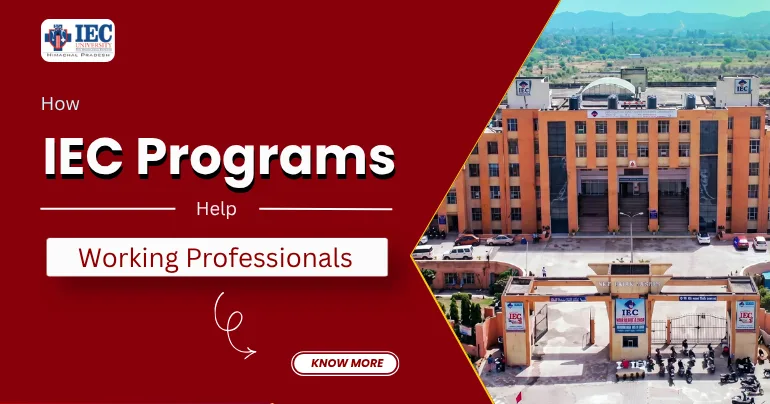
In today’s fast-changing technical and engineering landscape, professionals cannot rely only on experience to grow in their careers. Industries are evolving, technologies are advancing, and companies expect employees to upgrade their qualifications along with their skills. This is why many working professionals are now choosing flexible education options like IEC B.Tech and M.Tech programs.
These programs are designed specifically for individuals who want to continue working while upgrading their academic qualifications. They provide structured learning, industry-relevant knowledge, and the flexibility needed to balance work and study.
In this blog, we will explore how IEC B.Tech and M.Tech programs and their specializations help working professionals achieve long-term career growth.
Table of Contents
ToggleIEC B.Tech and M.Tech Program Overview for Working Professionals
IEC programs are structured to support professionals who cannot leave their job for full-time education.
| Basis | B.Tech Program | M.Tech Program |
| Level | Undergraduate | Postgraduate |
| Duration | 3 Years (Lateral Entry) | 2 Years |
| Mode | Flexible | Flexible |
| Suitable For | Diploma Holders / Working Professionals | Graduates / Working Engineers |
| Learning Approach | Practical + Technical | Advanced + Research-Based |
| Key Focus | Core Engineering Concepts | Specialized Engineering Knowledge |
Both programs are designed to provide a balance between theoretical knowledge and practical application.
Why Working Professionals Choose IEC B.Tech and M.Tech
Many professionals begin their careers with a diploma or basic qualification. Initially, growth may be steady, but after a few years, career progression can slow down.
Companies often require a B.Tech or M.Tech degree for higher technical roles, leadership positions, or project management responsibilities. Without these qualifications, professionals may find it difficult to move forward.
IEC programs provide a practical solution by allowing individuals to upgrade their qualifications without leaving their job.
IEC B.Tech vs M.Tech Specializations (Official Website Based)
| Basis | B.Tech Specializations | M.Tech Specializations |
| Program Level | Undergraduate | Postgraduate |
| Core Focus | Fundamental Engineering & Industry Skills | Advanced Technical & Specialized Knowledge |
| Computer Domain | Computer Science Engineering | Computer Science Engineering |
| Mechanical Domain | Mechanical Engineering | Mechanical Engineering |
| Civil Domain | Civil Engineering | — |
| Electrical Domain | Electrical Engineering | — |
| Electrical & Electronics | Electrical and Electronics Engineering | Electrical and Electronics Engineering |
| Electronics Domain | Electronics and Communication Engineering | — |
| Learning Outcome | Entry to Mid-Level Technical Roles | Senior, Specialized & Leadership Roles |
How IEC Programs Support Career Growth
One of the main reasons professionals choose these programs is career growth.
After completing B.Tech or M.Tech, individuals become eligible for better roles such as senior engineer, project manager, or technical lead.
The degree also enhances professional credibility, which plays an important role in career advancement.
Employers often prefer candidates with higher qualifications for leadership and specialized roles.
Practical Learning Approach in IEC Programs
IEC programs focus on practical and industry-oriented learning.
Instead of only theoretical concepts, the programs emphasize real-world applications. This helps professionals understand how to use their knowledge in actual work environments.
Assignments and projects are often designed around real engineering problems, making learning more relevant.
This approach helps professionals improve their performance at work.
Flexibility of IEC B.Tech and M.Tech Programs
Flexibility is one of the key advantages of these programs.
Working professionals often have limited time due to job responsibilities. IEC programs allow individuals to study according to their schedule.
Many professionals prefer studying during weekends or after work hours. This ensures that their job is not affected while they continue their education.
Skill Development Through IEC Programs
These programs help in developing both technical and professional skills.
Professionals improve their understanding of engineering concepts, which is essential for technical roles. At the same time, they develop skills such as problem-solving, analytical thinking, and decision-making.
M.Tech programs also focus on research and advanced analysis, which are important for higher-level roles.
These skills are valuable across industries.
Salary Growth After B.Tech and M.Tech
Upgrading your qualification often leads to better salary opportunities.
| Level | Before Degree (₹) | After B.Tech (₹) | After M.Tech (₹) |
| Early Career | ₹2 – ₹4 LPA | ₹4 – ₹7 LPA | ₹5 – ₹8 LPA |
| Mid-Level | ₹4 – ₹8 LPA | ₹6 – ₹12 LPA | ₹8 – ₹15 LPA |
| Senior Level | ₹8+ LPA | ₹10+ LPA | ₹15+ LPA |
These figures are general estimates and may vary depending on experience and industry.
Challenges of Studying While Working
While IEC programs are flexible, they still require effort and discipline.
Balancing work and study can be challenging, especially during busy work periods. Professionals need to manage their time effectively.
Consistency is important to complete the program successfully.
Understanding these challenges helps in preparing better.
Who Should Choose IEC B.Tech and M.Tech Programs
These programs are suitable for:
- Diploma holders who want to upgrade to B.Tech
- Engineers who want to specialize through M.Tech
- Working professionals looking for career growth
- Individuals who prefer flexible learning options
They are ideal for those who want long-term development without leaving their job.
Important Things to Consider Before Enrolling
Before enrolling, it is important to evaluate your goals.
Choose a specialization that aligns with your career path. Make sure you can manage both work and study effectively.
Also, ensure that you are ready to stay consistent throughout the program.
Making a clear decision will help you achieve better results.
Conclusion
IEC B.Tech and M.Tech programs provide a flexible and practical pathway for working professionals to upgrade their qualifications.
They allow individuals to continue working while gaining technical knowledge and improving their skills. The availability of multiple specializations makes it easier to align education with career goals.
While these programs require commitment and time management, the long-term benefits can be significant.
If you are focused on career growth and willing to put in the effort, IEC programs can help you move forward in your professional journey.
Frequently Asked Questions
1. Can I do IEC B.Tech while working full-time
Yes, the program is designed for working professionals with flexible study options.
2. What is the duration of IEC B.Tech and M.Tech
B.Tech takes around 3 years for diploma holders, and M.Tech takes about 2 years.
3. Do IEC programs offer different specializations
Yes, both B.Tech and M.Tech programs offer multiple engineering specializations.
4. Do these programs help in career growth
Yes, they improve qualifications and increase opportunities for better roles.
5. Is it difficult to manage study with work
It can be challenging, but proper time management makes it manageable.